
Contributed by the U.S. Bureau of Labor Statistics
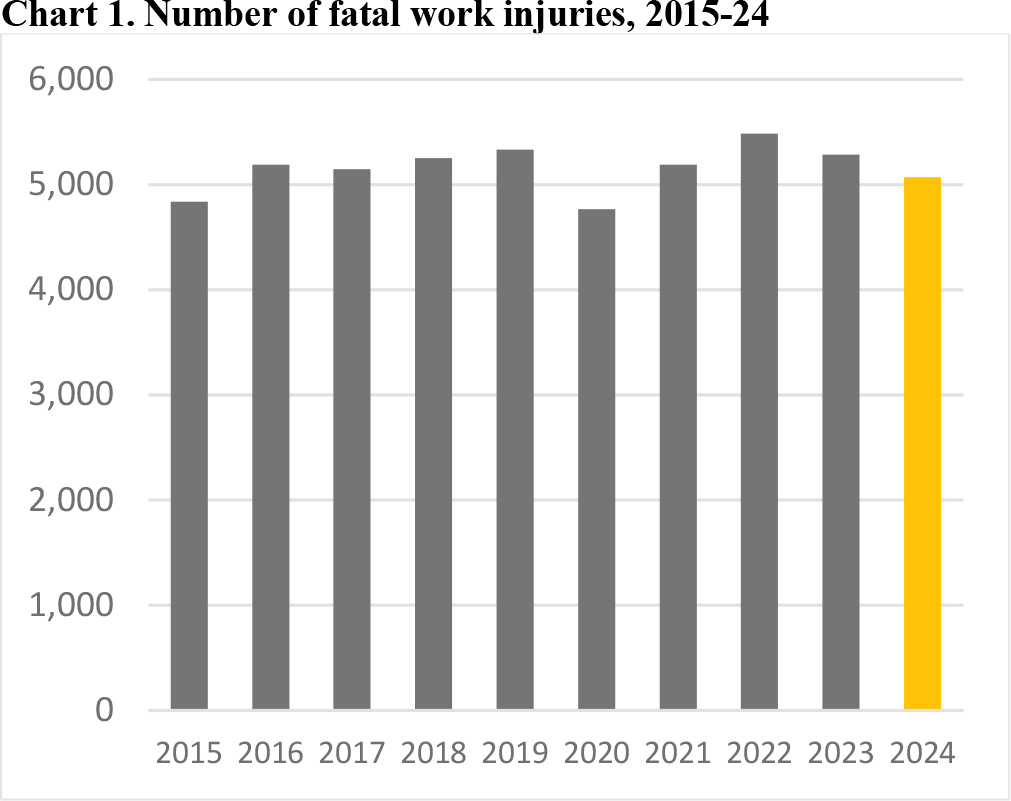
There were 5,070 fatal work injuries recorded in the United States in 2024, down 4.0 percent from 5,283 in 2023, the U.S. Bureau of Labor Statistics reported today. (See chart 1 and table 1.) The fatal work injury rate was 3.3 fatalities per 100,000 full-time equivalent (FTE) workers in 2024, a decrease from a rate of 3.5 in 2023. (See chart 2.) These data are from the Census of Fatal Occupational Injuries (CFOI).

Key findings
- A worker died every 104 minutes from a work-related injury in 2024 compared to 99 minutes in 2023.
- The fatal injury rate of 3.3 fatalities per 100,000 FTE workers decreased for the second year in a row.
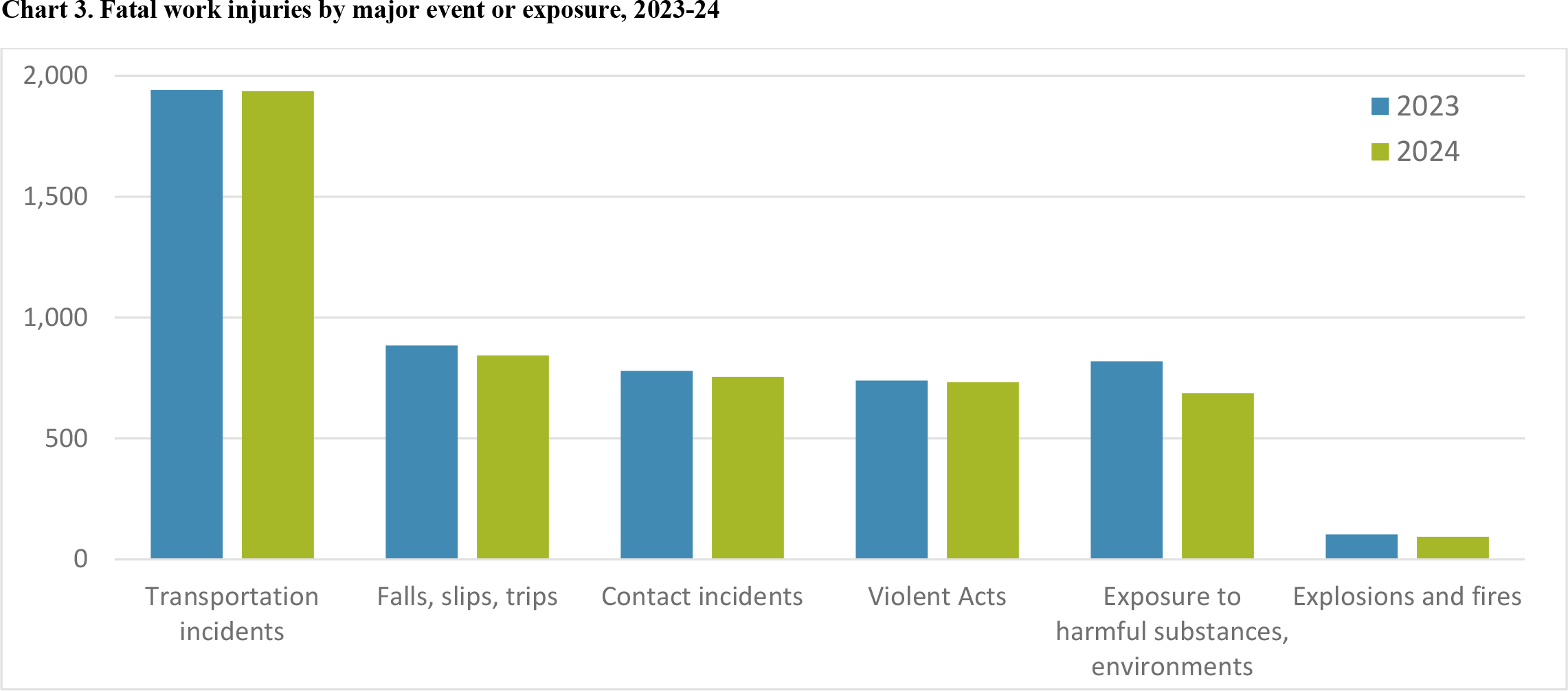
- The decrease in fatal injuries in 2024 was largely driven by a 16.2 percent drop in fatalities due to exposure to harmful substances or environments (to 687 cases from 820). This decrease was in turn driven by a decline in drug or alcohol overdoses which accounted for 59.7 percent of fatalities in this category, dropping to 410 fatal injuries in 2024 from 512 fatalities in 2023.
- Workers in transportation and material moving occupations represented the occupational group with the most fatalities with 1,391 fatal work injuries in 2024, though this was a 7.0-percent decrease from 2023 (1,495). The fatality rate for these workers was 12.5 fatalities per 100,000 FTE workers in 2024, down from 13.6 in 2023.
Worker characteristics
- Women accounted for 8.1 percent (413) of all worker fatalities but 15.3 percent (72) of fatalities due to homicides in 2024.
- The fatal injury count and rate for Black or African American workers decreased in 2024. The count decreased to 624 in 2024 from 659 in 2023 and the rate decreased to 3.4 fatalities per 100,000 FTE workers in 2024 from 3.6 in 2023.
- The fatal injury rate for Hispanic or Latino workers dropped to 4.3 fatalities per 100,000 FTE workers in 2024 from 4.4 in 2023. Of the 1,229 fatalities to these workers in 2024, 68.5 percent (842) occurred among foreign-born Hispanic or Latino workers.
Fatal event or exposure
- Fatalities due to violent acts decreased to 733 in 2024 from 740 in 2023. Homicides accounted for 64.1 percent of this category with 470 fatalities, up from 458 in 2023. Suicides accounted for the other 35.9 percent with 263 fatalities, down from 281 in 2023.
- Transportation incidents continue to be the most frequent type of fatal event, accounting for 38.2 percent of all occupational fatalities in 2024. The total number of fatal transportation incidents decreased to 1,937 in 2024 from 1,942 in 2023.
- Roadway incidents involving motorized land vehicles decreased 8.5 percent to 1,146 in 2024 from 1,252 in 2023, while pedestrian incidents involving motorized land vehicles increased 19.0 percent to 369 in 2024 from 310 in 2023.
- Fatal falls, slips, and trips decreased 4.6 percent to 844 in 2024 from 885 in 2023. In 2024, 10.8 percent of these fatalities were a result of a worker falling from a height over 30 feet.
Occupation
- Construction and extraction workers experienced 1,032 fatalities in 2024. Fatal falls, slips, and trips among these workers decreased 7.5 percent to 370 in 2024 from 400 in 2023.
- Work fatalities among building and grounds cleaning and maintenance workers increased to 356 in 2024
from 337 in 2023. - Fatalities among protective service occupations slightly increased to 281 in 2024 from 276 in 2023. Homicides (97) accounted for 34.5 percent of these fatalities in 2024.
Fatal injury counts and rates by occupation, industry, and worker demographics are available here.
TECHNICAL NOTES
Background
The Census of Fatal Occupational Injuries (CFOI), part of the Bureau of Labor Statistics (BLS) Injuries, Illnesses, and Fatalities (IIF) program, is a count of all fatalities resulting from workplace injuries occurring in the U.S. during the calendar year. The CFOI uses a variety of state, federal, and independent data sources to identify, verify, and describe fatal work injuries. This ensures counts are as complete and accurate as possible. For the 2024 data, over 25,500 unique source documents were reviewed as part of the data collection process. For technical information and definitions for the CFOI, see the BLS Handbook of Methods on the BLS website and the CFOI definitions. Fatal injury rates are subject to sampling error as they are calculated using employment data from the Current Population Survey, a sample of households, and the BLS Local Area Unemployment Statistics. For more information on sampling error, see the Reliability of Estimates.
The Survey of Occupational Injuries and Illnesses (SOII), another component of the IIF program, presents frequency counts and incidence rates by industry, detailed case circumstances, and worker characteristics for nonfatal workplace injuries and illnesses for cases that result in days away from work and days of job transfer or restriction. For these data, go to the BLS website.
Identification and verification of work-related fatalities
In 2024, work relationship could not be independently verified by multiple source documents for 34 fatal work injuries. However, the information on the initiating source document for these cases was sufficient to determine that the incident was likely to be job-related. Data for these fatalities are included.
Federal/State agency coverage
The CFOI includes data for all fatal work injuries, some of which may be outside the scope of other agencies or regulatory coverage. Comparisons between CFOI counts and those released by other agencies should account for the different coverage requirements and definitions used by each agency. For more information on the scope of CFOI, see the CFOI Scope and Concepts.
Latency Cases
Latent fatal occupational injury cases occur when the date of injury differs from the date of death. In some cases, the death occurs in a different year than the occupational injury and are known as cross-year latent cases. In 2024, there were 215 cases where this occurred, and 190 of these latent cases occurred more than 30 days prior to the start of 2024. More information on latent cases here.
Acknowledgements
BLS thanks the participating states, New York City, the District of Columbia, Puerto Rico, the U.S. Virgin Islands, and Guam for their efforts in collecting accurate, comprehensive, and useful data on fatal work injuries. Although data for Puerto Rico, the U.S. Virgin Islands, and Guam are not included in the national totals, results for these jurisdictions are available. Participating agencies may be contacted to request more detailed state results. Contact information is available at here.
BLS also appreciates the efforts of all federal, state, local, and private sector entities that provided source documents used to identify fatal work injuries. Among these agencies are the Occupational Safety and Health Administration; the National Transportation Safety Board; the U.S. Coast Guard; the Mine Safety and Health Administration; the Office of Workers’ Compensation Programs (Federal Employees’ Compensation and 3 Longshore and Harbor Workers’ Compensation divisions); the Federal Railroad Administration; the National Highway Traffic Safety Administration; state vital statistics registrars, coroners, and medical examiners; state departments of health, labor, and industrial relations and workers’ compensation agencies; state and local police departments; and state farm bureaus.
If you are deaf, hard of hearing, or have a speech disability, please dial 7-1-1 to access telecommunications relay services.

1 The Census of Fatal Occupational Injuries (CFOI) has published data on fatal occupational injuries for the United States since 1992. During this time, the classification systems and definitions of many data elements have changed. See the CFOI Definitions page for a more detailed description of each data element.
2 May include volunteers and workers receiving other types of compensation. Cases where employment status is unknown are included in the counts of wage and salary workers.
3 Includes self-employed workers, owners of unincorporated businesses and farms, paid and unpaid family workers, and may include some owners of incorporated businesses or members of partnerships.
4 Persons identified as Hispanic or Latino may be of any race. The race categories shown exclude data for Hispanics and Latinos. Cases where ethnicity is unknown are included in counts of non-Hispanic workers.
Note: Data for all years are revised and final. Totals for major categories may include subcategories not shown separately. CFOI fatal injury counts exclude illness-related deaths unless precipitated by an injury event
Source: U.S. Department of Labor, Bureau of Labor Statistics, in cooperation with state, New York City, District of Columbia, and federal agencies, Census of Fatal Occupational Injuries

1 The Census of Fatal Occupational Injuries (CFOI) has published data on fatal occupational injuries for the United States since 1992. During this time, the classification systems and definitions of many data elements have changed. See the CFOI Definitions page for a more detailed description of each data element.
2 Based on the BLS Occupational Injury and Illness Classification System (OIICS) version 3 implemented for 2023 data forward.
Note: Data for all years are revised and final. Totals for major categories may include subcategories not shown separately. CFOI fatal injury counts exclude illness-related deaths unless precipitated by an injury event.
Source: U.S. Department of Labor, Bureau of Labor Statistics, in cooperation with state, New York City, District of Columbia, and federal agencies, Census of Fatal Occupational Injuries

1 The Census of Fatal Occupational Injuries (CFOI) has published data on fatal occupational injuries for the United States since 1992. During this time, the classification systems and definitions of many data elements have changed. See the CFOI Definitions page for a more detailed description of each data element.
2 CFOI has used several versions of the Standard Occupation Classification (SOC) system since 2003 to define occupation. For complete information on the version of SOC used in these years, see the CFOI definitions page. Cases where occupation is unknown are included in the total.
Note: Data for all years are revised and final. Totals for major categories may include subcategories not shown separately. Dashes indicate no data reported or data that do not meet publication criteria. CFOI fatal injury counts exclude illness-related deaths unless precipitated by an injury event.
Source: U.S. Department of Labor, Bureau of Labor Statistics, in cooperation with state, New York City, District of Columbia, and federal agencies, Census of Fatal Occupational Injuries